- Cryptography
How Encryption Algorithms Actually Work (Without the Math Headache)
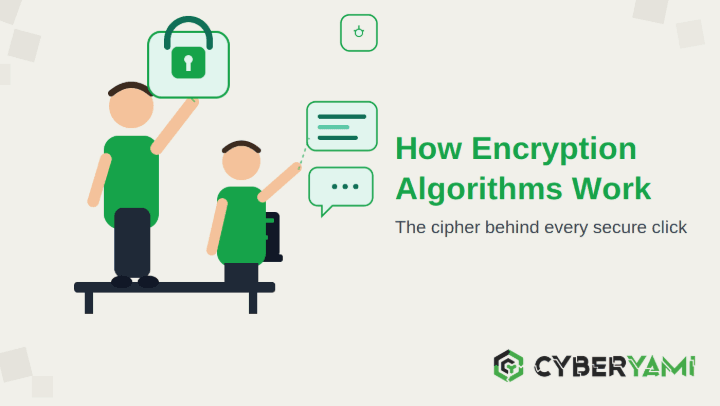
Every time you check your bank balance, send a WhatsApp message, or see that little padlock icon in your browser, encryption is working behind the scenes. But how does it actually turn your data into gibberish — and back again — without anyone else being able to peek? Let's break it down.
So, What Is Encryption, Really?
At its core, encryption takes readable data — your password, a message, a file — and scrambles it into something unreadable using a mathematical algorithm and a key. Only someone with the right key can unscramble it and recover the original data. Before we get into the different types, it helps to remember one thing: data doesn't stay safe just because a network is well-designed.
Think of it like a lockbox: anyone can see the box, but only the person with the right key can open it. The box itself (the algorithm) isn't a secret — it's the key that matters.
Why It Matters
Even if a hacker intercepts your encrypted data in transit, it's useless to them without the key. That's the entire point.
The Two Big Families of Encryption
Almost every encryption system you'll encounter falls into one of two categories: symmetric or asymmetric. To see why that matters, start with the simpler one first. Understanding the difference is really the whole ballgame.
Symmetric Encryption: One Key, Shared Secretly
Symmetric encryption uses the same key to both encrypt and decrypt data. It's fast, efficient, and perfect for encrypting large amounts of information — think encrypted hard drives, VPN traffic, or Wi-Fi connections.
The gold standard here is AES (Advanced Encryption Standard). It takes your data, breaks it into blocks, and puts each block through multiple rounds of scrambling — swapping bytes, shifting rows, mixing columns, and blending in pieces of the key. Do this enough times, and the output is virtually impossible to reverse without the key.
The catch? Both sides need the same secret key, and getting that key safely from one person to another without anyone intercepting it is genuinely tricky. That's why the next approach exists. It's also why key length matters so much — short keys leave a system exposed to brute force attacks on encryption keys, where an attacker simply tries every possible key until one works.
Asymmetric Encryption: Two Keys, One Public
Asymmetric encryption solves that key-sharing problem by using two mathematically linked keys instead of one: a public key anyone can see, and a private key only you hold. Encrypt something with the public key, and only the matching private key can decrypt it.
RSA is the classic example. It leans on a simple but powerful fact: multiplying two huge prime numbers together is easy, but figuring out those two primes from the result alone is brutally hard — even for a computer. That imbalance is what keeps RSA secure.
A newer alternative, ECC (Elliptic Curve Cryptography), achieves the same security with far smaller keys, which is why it's become the go-to choice for mobile devices and IoT gadgets that can't afford heavy computation.
The trade-off with asymmetric encryption is speed — it's much slower than symmetric encryption, so it's rarely used to encrypt entire files. Instead, it's typically used to safely exchange a symmetric key, which then does the heavy lifting. That setup leads naturally into hashing, which is different again.
Symmetric vs. Asymmetric, at a Glance
| Factor | Symmetric | Asymmetric |
| Keys used | One shared secret key | Public + private key pair |
| Speed | Fast | Slower |
| Best for | Encrypting large amounts of data | Securely exchanging keys, verifying identity |
| Examples | AES, ChaCha20 | RSA, ECC, Diffie-Hellman |
What About Hashing? Isn't That Encryption Too?
Not quite — and this trips people up all the time. Hashing takes data and turns it into a fixed-length string, but it's a one-way street. From there, the key point is that there's no way to recover the original data.
That makes hashing perfect for checking that data hasn't been tampered with, rather than keeping it secret. A good hash function is deterministic (same input, same output every time), practically impossible to reverse, and extremely unlikely to produce the same result for two different inputs.
Common Mix-Up
Your passwords should be hashed, not encrypted. Hashing is one-way, so even the company storing your password can't 'decrypt' it and read it back — they can only compare hashes.
MD5 and SHA-1 were once popular hashing algorithms but are now considered broken for security reasons. Today, SHA-256 and SHA-3 are the standards you'll see in password storage, blockchain, and digital signatures. This same one-way property is what makes hashing so useful in digital forensics, where investigators need to prove a piece of evidence hasn't been altered since it was collected.
How It All Comes Together: HTTPS
Here's where it gets satisfying — real systems don't pick one method; they combine all three. Take HTTPS, the padlock in your browser, and here's how it works:
- First, your browser and the website perform a quick handshake using asymmetric encryption to confirm the site is really who it claims to be and to agree on a shared secret.
- Once that secret is set, both sides switch to fast symmetric encryption (usually AES) to protect the actual data flowing back and forth.
- Meanwhile, hashing quietly checks that nothing was altered in transit.
Three different tools, each doing what it's best at, work together in the background every time you browse. This is also exactly the kind of encrypted traffic that SOC analysts rely on to spot when something looks off — even without decrypting the payload itself. Digital signatures add one more layer of trust.
One more piece worth knowing: digital signatures. They combine hashing and asymmetric encryption to prove a message really came from who it says it did, and that it wasn't changed along the way.
The sender hashes their message, then encrypts that hash with their own private key — that's the signature. Anyone with the sender's public key can decrypt the message, hash it, and verify that the two match. If they do, the message is authentic and untampered.
The Takeaway
Encryption isn't one single trick — it's a toolkit. Symmetric encryption keeps large amounts of data safe and fast. Asymmetric encryption solves the problem of sharing secrets over an untrusted network. Hashing makes sure nothing's been quietly altered. Together, they keep the internet secure and trustworthy every day.
Next time you see that padlock icon, you'll know how much is happening behind the scenes to keep your data safe. Want to go beyond reading about it? Our hands-on cybersecurity training lets you work directly with these concepts in guided labs.
Related Reads
• What is a Brute Force Attack? Tools, Types & Techniques
• What is Digital Forensics? Types, Tools, and Techniques
•Capture-The-Flag (CTF) in Cyber Security: All You Ever Wanted to Know
Recent Blogs
How Encryption Algorithms Actually Work (Without the Math Headache)

Why Employee Awareness Training Is Your Cheapest Insurance Policy

From People to Processes: How Integrated Cybersecurity Training Platforms Elevate Organizational Readiness

Zero Trust for Beginners: Why "Trust No One" is Your Best Defense
Supply Chain Attacks: Protecting Your Business Ecosystem

Top 30 SOC Analyst Interview Questions and Answers for 2025
The Role of Certifications in Bridging the Cybersecurity Skills Gap

Why Every Business Needs Tailored Cybersecurity Training

Unveiling Lucrative Paths: Exploring Cybersecurity Career Opportunities