- Human Risk Management
Why Employee Awareness Training Is Your Cheapest Insurance Policy
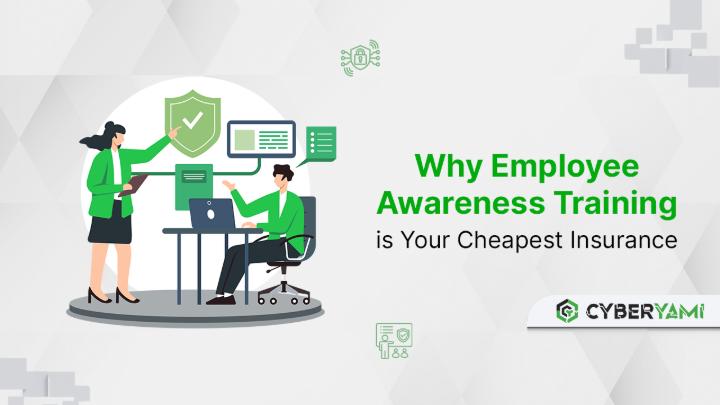
Ask most finance teams to justify a line item, and they want a return-on-investment number. Security awareness training is one of the rare enterprise expenses where that number is almost embarrassingly easy to build — and yet it's still the first thing cut when budgets tighten, because it doesn't feel like "real" security the way a firewall or an EDR license does.
Here's the case, in numbers.
Key Figures at a Glance
| Figure | What it means |
| $12–$36 | Cost per employee per year for a structured security awareness training program |
| $4.44M | Global average cost of a data breach in 2025 (IBM) |
| $4.8M | Average cost of a breach specifically caused by phishing (IBM 2025) |
| 26% | Of breaches caused by human error (IBM 2025) |
| ~60% | Of breaches involving the human element in some form (Verizon DBIR 2025) |
| 44% | Of breaches involving ransomware in 2025, up from 32% the year before |
| 40% → 86% | Reduction in phishing susceptibility: 90 days vs. 1 year of structured training (SANS 2025) |
The Math Nobody Puts in the Budget Meeting
Enterprise-grade security awareness training costs roughly $12 to $36 per employee per year for most mid-sized organizations, depending on the platform tier and whether phishing simulation and coaching are bundled. (Security Awareness Training Cost in 2025 | Consilien, 2026) For a 1,000-person org, that's a training budget most companies could round up from a rewards-and-recognition line item.
Now, the other side of the ledger. The global average cost of a data breach in 2025 came in at $4.44 million — and that figure is after a rare year-over-year drop, driven mostly by faster detection and containment, not by fewer incidents. (Institute, n.d.) Breaches involving phishing as the entry point averaged $4.8 million per successful breach when incident response, forensics, legal fees, regulatory fines, and customer notification are included. (Team, 2026)
Run even a conservative version of the math — a modest probability of a breach in any given year, a training program that cuts phishing susceptibility by a fraction — and the expected-value case clears the training budget by an order of magnitude before you've accounted for anything else training touches: faster reporting of suspicious activity, fewer help-desk resets from credential mishaps, a workforce that at least hesitates before wiring money to "the CEO."
Where the Money Actually Goes When a Breach Happens
The instinct is to picture a breach as a technical event — someone exploits a server, patches it, and that's it. The cost breakdown says otherwise. Human error accounts for 26% of data breaches, with IT failures responsible for another 23% — meaning roughly half of all breaches trace back to something a person did or didn't do, not a zero-day exploit. (2025 Data Breach Investigations Report, n.d.) Verizon's 2025 Data Breach Investigations Report puts it even more starkly: the human element accounted for about 60% of the breaches it analyzed. (Business, 2025)
The threat landscape isn't making this easier. Generative AI has collapsed the time it takes to write a convincing phishing email — what used to take an attacker 16 hours to craft can now be generated in about 5 minutes, and it shows: AI-assisted phishing and deepfake impersonation are now among the most common ways breaches involving AI get their initial foothold. (Vyntra, 2026) Ransomware, too, is climbing — present in 44% of breaches in 2025, up from 32% the year before. (2025 Global Data Breach Report, n.d.)
None of this is stopped by a firewall. It's stopped — or isn't — by whether the person who received that email knew what to look for and had a clear, fast way to report it. If it isn't stopped, the clock immediately starts on incident response — see our checklist for what to do when your business faces a cyber attack for what happens next.
Why "Awareness" Alone Isn't the Answer Either
This is the part most vendors skip past, and it matters: awareness training that consists of an annual click-through video and a quiz doesn't move the needle much, and everyone running a serious program knows it. The data support doing this properly rather than performatively — organizations running structured, ongoing training programs see a phishing-risk reduction of around 40% within 90 days, rising to as much as 86% within a year, according to SANS' 2025 research. (Toth et al., 2025) That's the difference between training as a checkbox and training as a measured, iterated program with simulated phishing, real reporting metrics, and follow-up coaching for repeat clickers.
This is also exactly the gap between "awareness training" and human risk management: awareness tells someone what phishing looks like once a year; human risk management tracks who's still clicking, who's improving, and gives security leadership an actual risk score to report to the board — the same way they'd report on patch compliance or endpoint coverage. If you can't measure it, you can't defend its budget next year either.
The Literal Insurance Angle
The "insurance policy" framing in this post's title isn't just a metaphor anymore. Most cyber insurance policies now require evidence of annual security training with quarterly updates as a condition of coverage — insurers have caught up to the same data everyone else has, and they're pricing risk accordingly. (Madaniev, 2026) Underwriters increasingly want to see functioning, measurable training programs, not a policy document sitting in a compliance folder that nobody's opened since it was signed.
That means a weak or absent training program isn't just a security gap anymore — for a growing number of organizations, it's the difference between a claim getting paid and getting denied, or between a renewable premium and a non-renewal notice.
What This Looks Like Done Right
The organizations getting real value out of this spend aren't buying a training module and walking away. They're running programs with a few consistent traits:
- Simulated phishing that mirrors real attacker behavior — not obviously fake test emails, but the kind of AI-assisted, well-targeted attempts employees are actually seeing now
- A human risk score, not just a completion rate — tracking who's improving, who's a repeat risk, and rolling that into a number leadership can actually act on
- Fast, frictionless reporting — if flagging a suspicious email takes five clicks, most people won't bother, and the training's value drops with it
- Governance tied to the training, not separate from it — the same program that trains employees should feed into the risk reporting your ISO 27001, SOC 2, or DPDP compliance documentation needs anyway
This is the layer Cyberyami's Human Risk Management platform is built around — phishing simulation, human risk scoring, and reporting designed to give CISOs and CHROs a defensible, board-ready answer to "what are we doing about our biggest attack surface," instead of a training completion certificate nobody asked for.
If you're building the business case internally, the framing that tends to land with finance is simple: you're not asking for a training budget; you're asking to insure against the single most common cause of the most expensive line item in the security budget — and the premium is a fraction of a percent of what the incident costs.
FAQs
How much does employee security awareness training actually cost per year?
Most mid-sized organizations pay $12–$36 per employee per year for a structured program that includes phishing simulation, though enterprise platforms with human risk scoring and coaching can cost more.
Does security awareness training really reduce breach risk, or is that theoretical?
It's measurable. Structured programs with ongoing simulation — not one-off annual training — have been shown to cut phishing susceptibility by roughly 40% within 90 days and up to 86% within a year, per SANS' 2025 research.
Is employee training actually required for cyber insurance now?
Increasingly, yes. Most cyber insurance carriers now require evidence of an active, ongoing training program as a condition of coverage or renewal, rather than a one-time policy attestation.
What's the difference between security awareness training and human risk management?
Awareness training teaches employees to recognize threats. Human risk management goes further — it measures and scores that risk over time, so security leadership can report and act on it the way they would any other security metric.
Want to see what a measurable human risk program looks like for your organization? Talk to Cyberyami about the Human Risk Management platform, or explore tailored training solutions built for enterprise teams.
Sources: IBM Cost of a Data Breach Report 2025 · Verizon 2025 Data Breach Investigations Report (DBIR) · SANS Institute 2025 Security Awareness Report · Industry pricing analysis, security awareness training vendor benchmarks, 2025–2026
Related Reads
- Human Errors in Cyber Security: 5 Common Mistakes Caused by Employees
- Ways to Protect Your Business from Cyber Threats
- Cybersecurity in the Workplace: Best Practices for Employers and Employees
- Cybersecurity vs. Information Security: What's the Difference?
References
(2026). Security Awareness Training Cost in 2025 | Consilien. Consilien. https://consilien.com/news/how-much-does-security-awareness-training-cost-in-2025-a-complete-pricing-guide
Institute, P. (n.d.). Cost of a Data Breach Report 2025. https://www.ibm.com/reports/data-breach
Team, L. (July 5, 2026). Cost of a Data Breach: Fines, Lawsuits, and Recovery Times. LegalClarity. https://legalclarity.org/cost-of-a-data-breach-fines-lawsuits-and-recovery-times/
(n.d.). 2025 Data Breach Investigations Report. https://www.verizon.com/about/news/2025-data-breach-investigations-report-emea
Business, V. (April 23, 2025). Verizon’s 2025 Data Breach Investigations Report: System intrusion breaches double in EMEA. Verizon. https://www.verizon.com/about/news/2025-data-breach-investigations-report-emea
Vyntra. (April 15, 2026). From 16 hours to under 5 minutes: How Gen AI is turning fraud into a $400B+ global industry - and experts warn that it's just the beginning. TechRadar. https://www.techradar.com/pro/security/from-16-hours-to-under-5-minutes-how-gen-ai-is-turning-fraud-into-a-usd400b-global-industry-and-experts-warn-that-its-just-the-beginning
(n.d.). 2025 Global Data Breach Report. https://exposedmap.com/report/2025
Toth, R., Dubniczky, R. A., Limonova, O. & Tihanyi, N. (2025). Sustaining Cyber Awareness: The Long-Term Impact of Continuous Phishing Training and Emotional Triggers. arXiv preprint arXiv:2510.27298. https://doi.org/10.48550/arXiv.2510.27298
Madaniev, S. (2026). Cyber Insurance Readiness Checklist. Protectyr. https://protectyr.com/help/cyber-insurance-readiness-checklist
Recent Blogs
How Encryption Algorithms Actually Work (Without the Math Headache)
Why Employee Awareness Training Is Your Cheapest Insurance Policy
From People to Processes: How Integrated Cybersecurity Training Platforms Elevate Organizational Readiness
Zero Trust for Beginners: Why "Trust No One" is Your Best Defense
Supply Chain Attacks: Protecting Your Business Ecosystem
Top 30 SOC Analyst Interview Questions and Answers for 2025
The Role of Certifications in Bridging the Cybersecurity Skills Gap
Why Every Business Needs Tailored Cybersecurity Training

Unveiling Lucrative Paths: Exploring Cybersecurity Career Opportunities