- Ethical Hacking types
What is Ethical Hacking ? Importance, Phases & Types
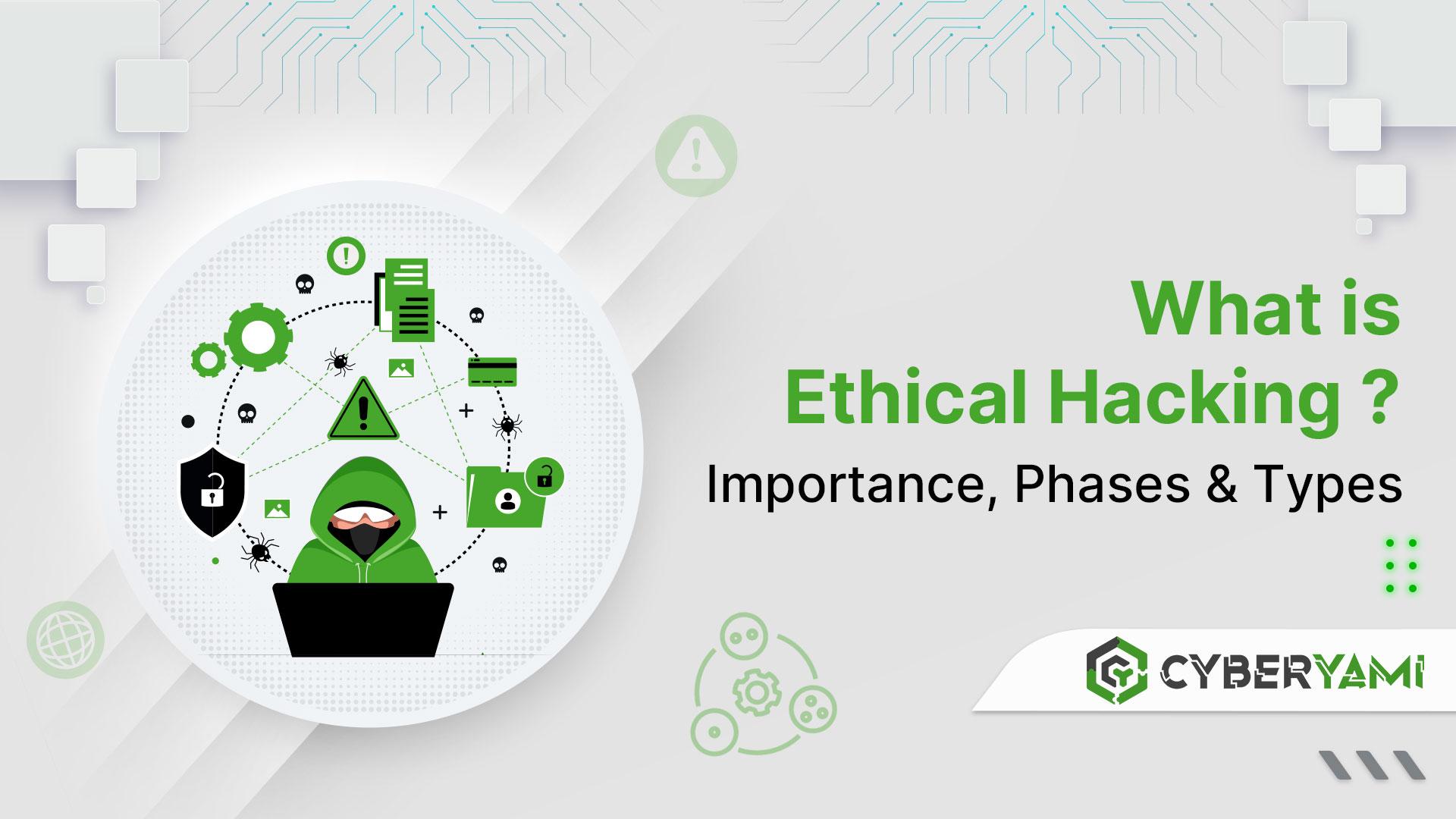
Ethical hacking as a career remains one of the most rewarding paths in cybersecurity — and the demand hasn't cooled. In today's interconnected world, where digital security is paramount, "hacking" often conjures images of malicious actors breaching systems for gain. But there's a legitimate, structured discipline that uses the same techniques for defense: ethical hacking.
What is Ethical Hacking?
Ethical hacking, also known as penetration testing or white-hat hacking, is the practice of systematically attempting to exploit vulnerabilities in computer systems, networks, or applications with the explicit permission of their owners. The goal is to find weaknesses before someone without permission does.
Ethical hackers use the same tools and techniques as malicious hackers, but under legal authorization and a strict code of ethics. They typically follow a structured approach — reconnaissance, scanning, gaining access, maintaining access, and covering tracks — to uncover vulnerabilities and assess overall security posture.
Importance of Ethical Hacking
- Identifying Vulnerabilities — finding weaknesses before attackers do.
- Enhancing Security Measures — turning findings into concrete, prioritized fixes.
- Compliance Requirements — many regulatory frameworks (PCI DSS, HIPAA, GDPR, and increasingly India's DPDP Act) require regular security assessments.
- Protecting Sensitive Information — personal data, financial records, and IP.
- Maintaining Trust — demonstrating proactive security builds confidence with customers and partners.
- Cost Savings — fixing vulnerabilities early is consistently cheaper than remediating a breach; see our breakdown of what a breach actually costs versus what prevention costs for the numbers.
- Continuous Improvement — threats evolve constantly, and ethical hacking keeps defenses current rather than static.
One thing that's changed materially by 2026: AI has entered both sides of this equation. Attackers use generative AI to write more convincing phishing and probe for vulnerabilities faster; defenders — including ethical hackers — increasingly use AI-assisted tooling to triage findings and simulate attack paths at a scale manual testing alone can't match. The fundamentals below still hold; the tooling around them has just gotten faster.
Types of Ethical Hackers
Ethical hacking spans several types of security assessment, each covering a different part of an organization's infrastructure:
- [Network Penetration Testing](https://www.cyberyami.com/skillup/network-fundamental) — assessing routers, switches, firewalls, and other network devices.
- Web Application Testing — identifying vulnerabilities like SQL injection, XSS, and insecure authentication.
- Wireless Network Testing — assessing Wi-Fi and Bluetooth security, weak encryption, and misconfigured access points.
- Social Engineering — testing whether employees can be manipulated into revealing sensitive information; see our related piece on human errors in cybersecurity for the patterns attackers exploit.
- Physical Security Testing — assessing access controls, surveillance, and on-site security.
- Operating System Testing — Windows, Linux, and macOS vulnerabilities and misconfigurations.
- IoT Testing — smart devices, cameras, and connected hardware.
- Cloud Security Testing — AWS, Azure, GCP misconfigurations, insecure APIs, and identity/access weaknesses — is increasingly the highest-volume category as more infrastructure moves to the cloud. (Sadon & Galea, 2024)
Benefits of Ethical Hacking
- Enhanced Security — uncovering weaknesses before malicious actors do.
- Risk Reduction — lowering the likelihood of breaches, financial loss, and reputational damage.
- Compliance — demonstrating adherence to PCI DSS, HIPAA, GDPR, and similar standards.
- Cost Savings — remediation is consistently cheaper than breach recovery.
- Improved Incident Response — findings sharpen response plans before they're needed in real life.
- Educational Value — practitioners build a genuine understanding of the attacker's mindset and techniques.
- Customer Trust — visible security investments build confidence among clients and stakeholders.
- Innovation — a culture of continuous testing keeps defenses evolving alongside the threat landscape.
Ethical Hacking Phases
Ethical hacking follows a structured methodology, though specifics vary by framework:
Reconnaissance (Information Gathering) — passive (OSINT, public records) and active (network scanning) collection of information about the target.
Scanning — identifying live hosts, open ports, and running services using tools like Nmap, Nessus, or OpenVAS.
Enumeration — probing deeper for user accounts, shares, and services, including brute-force attempts and traffic analysis.
Vulnerability Analysis — assessing what was found against known weaknesses, prioritized by risk level.
Exploitation — attempting to exploit identified vulnerabilities to gain unauthorized access, using automated tools or manual techniques.
Post-Exploitation — maintaining access, escalating privileges, and gathering further information, mirroring what a real attacker would do next.
Reporting — documenting findings with proof-of-concept evidence, prioritized by severity and business impact.
Remediation — the organization patches, reconfigures, and retrains in response to the report's recommendations.
Are You Ready to Take Your Cybersecurity Career to the Next Level?
Cyberyami's Certified Penetration Testing Professional (C|CPTP) certification integrates penetration testing with ethical hacking principles, and is designed to make you job-ready rather than just exam-ready.
Why it's worth pursuing:
- Skill Validation — proof of capability for employers and clients
- Career Advancement — a credential that opens doors to new roles and transitions
- Industry Recognition — signals genuine, ongoing professional development
- Competitive Edge — differentiation in a crowded early-career field
- Global Recognition — value that travels across borders and employers
Conclusion
Ethical hacking remains one of the clearest ways to build a hands-on cybersecurity career — fortifying defenses, protecting sensitive data, and building trust in the systems we all depend on. As threats keep evolving, particularly with AI now on both sides of the fight, the discipline only becomes more essential, not less.
Related Reads
- What is Cybersecurity? Definition, Types, Careers, Salary, and Certifications
- What is Penetration Testing? Lifecycle & Types of Penetration Testing
- Penetration Testing Certifications: Which One Is Right for You?
- Ethical Hacking Certifications: Which Ones Are Worth Pursuing?
References
Sadon, S. & Galea, D. (February 27, 2024). 2024 State of Cloud Security Report: Top Cloud Security Risks. Orca Security. https://orca.security/resources/blog/2024-state-public-cloud-report-risk-prioritization/
Recent Blogs
How Encryption Algorithms Actually Work (Without the Math Headache)
Why Employee Awareness Training Is Your Cheapest Insurance Policy
From People to Processes: How Integrated Cybersecurity Training Platforms Elevate Organizational Readiness
Zero Trust for Beginners: Why "Trust No One" is Your Best Defense
Supply Chain Attacks: Protecting Your Business Ecosystem
Top 30 SOC Analyst Interview Questions and Answers for 2025
The Role of Certifications in Bridging the Cybersecurity Skills Gap
Why Every Business Needs Tailored Cybersecurity Training

Unveiling Lucrative Paths: Exploring Cybersecurity Career Opportunities